


18 December 2025
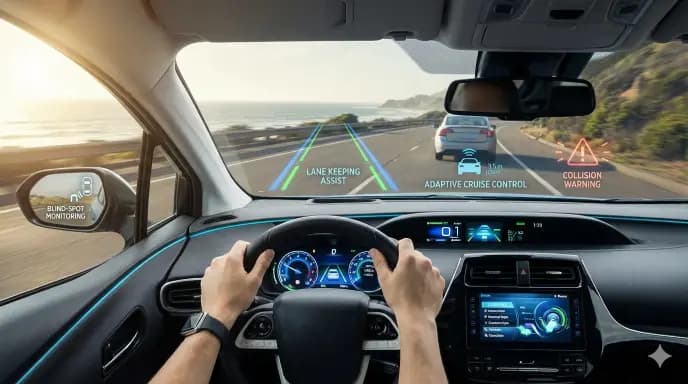
Active Safety Features: Everything you need to know
When you are driving, the most important thing to keep in mind is staying safe on the road. That is where the car safety features provide you with a perfect means to achieve this goal. What are the safety features that you should focus on? This blog is an attempt at helping you find the best ways to stay safe on the road. We will have a look at the active safety features and how they work.
What Are Active Safety Features?
Your vehicle includes several safety features that are now integral to modern automotive systems. But there are two different types of safety features provided in a vehicle. Passive safety features protect you after a crash. These include airbags and seatbelts. On the other hand, the active safety features work in real time and help you avoid the possibility or severity of an accident. These active features continuously monitor road conditions, your vehicle's stability, and traffic around you. In fact, it can be comparable to the defensive driver for you. The active safety systems anticipate the problems and protect you from them. The best part of the active safety system is that it operates independently. It does not need any action on your part. These features use sensors, cameras, radar, and computers to analyse your driving environment and respond instantly to detected danger.
Key Active Safety Features Available in Cars Today
Modern vehicles come with many active safety features. Let's break them down:
Anti-lock braking system : | The anti-lock braking system (ABS) prevents the wheels from locking up when you suddenly apply the brakes. If the wheels lock, the vehicle can skid and become hard to control. ABS helps you maintain steering and control even during hard braking. |
| Electronic stability control: | You can consider it as having a stability expert in your vehicle. It can automatically apply brakes when you are losing traction on the road. The action helps keep your vehicle stable and prevents it from skidding.
|
| Traction control system: | The system works with your engine and brakes to prevent the wheels from spinning excessively. This helps avoid excessive spinning when accelerating on slippery roads. It reduces power and applies the brakes to help your tyres maintain grip on the road. |
| Forward collision warning: | The system uses cameras and radar to monitor the vehicles ahead of you. It can detect when you are approaching another vehicle. You will be warned with visual and audible alerts. That should give enough time to react. |
Automatic emergency braking: | This will help you take collision avoidance to the next level. If a collision is likely and you do not respond quickly, the system automatically applies the brakes to slow your vehicle, stopping it instantly before impact. |
Lane Departure Warning (LDW) & Lane Keeping Assist (LKA): | These two systems work together to keep your vehicle in your lane. Lane Departure Warning (LDW) alerts you if you start to leave your lane without using your turn signal. The Lane Keeping Assist (LKA) gently steers or applies brakes to guide you back into your lane if you drift unintentionally. |
Adaptive Cruise Control: | It is an adaptive cruise control system which uses sensors to monitor the distance between your vehicle and the car ahead. You do not need to maintain a constant speed. It automatically adjusts your vehicle's speed to maintain a safe following distance. When traffic slows, your car slows. When it speeds up, you follow at a safe distance. |
Blind Spot Detection: | It helps you watch for dangerous areas, also known as blind spots, that you cannot see in your mirrors. It warns you if it detects a vehicle lurking in your blind spot. You will be alerted by a warning light on your side mirror or a beep. |
Rearview Camera & Parking Sensors: | The sensors make it easy to help you park and reverse your vehicle. The cameras will provide you with a clear view of what is behind you. The parking sensors help detect obstacles and let you decide how to approach them. |
Driver Attention Monitoring System: | A Driver Attention Monitoring System (DAMS) uses cameras to detect your eye and head movements. Imagine it senses signs of drowsiness or inattention. The system warns you to take a break, which can be lifesaving on long drives. |
How Active Safety Features Work Together?
The best part of the active safety features is that they work together. In any situation, all these systems act simultaneously. Let us take an example. Imagine you are driving on a wet, slippery highway and need to make an emergency manoeuvre.
The forward collision warning system detects a hazard and alerts you.
If you are slow to respond, the automatic emergency braking kicks in to slow your vehicle
Simultaneously, the traction control system helps maintain grip on the wet road.
Electronic stability control prevents skidding when you turn the wheel sharply.
Lane-keeping assist gently corrects your steering if you start to drift into another lane.
All these things happen in a few milliseconds. You can compare it to a group of professional drivers working together to prevent road disasters.
Also read, Top 10 tips to keep your car in good condition
Benefits of Cars Equipped with Active Safety Features
There are several advantages that you stand to gain from the active safety features. Here are the key benefits of cars equipped with active safety features:
| Accident prevention : | System features warn of hazards and help lower collision rates. |
| Lower repair costs : | You are preventing accidents, and that helps you save money that would be spent on repairs. Over the lifetime of your vehicle, it should be a huge saving. |
| Better control and experience : | Active safety features reduce stress and boost confidence in tough driving conditions. |
| Higher resale value : | This is a practical advantage that you stand to gain with any vehicle equipped with active safety features. Potential buyers find the active safety features a better option in any vehicle. |
Limitations of Active Safety Features
Of course, the active safety features are remarkable and practical. However, they still have a few limitations.
| Dependence on sensor accuracy: | These systems rely on cameras, radars, and other sensors, and their accuracy is critical. If a sensor is dirty or develops issues, its accuracy will be unreliable. |
| May not replace responsible driving: | Even with these unique safety features, an irresponsible driver may still not deliver the best results. These features work best when combined with attentive, defensive driving practices. |
| Weather limitations: | Adverse conditions can reduce the performance of ABS, traction control, and lane detection systems. |
Also read, How Collision Repair Impacts Your Car's Resale Value
How Indus Used Cars Ensures the Best Safety Standards in Every Vehicle?
Well, if you are buying a used car, safety should always be a top priority. Reputable used car dealers understand this and help you take additional steps to buy the right cars. We at Indus Used Cars can help you choose the best vehicle possible. We inspect every vehicle we sell. Our goal is to help you find models with key safety features. We demonstrate how these features work and answer your questions. Check out Indus Used Cars to find your next vehicle.